Is paid search ineffective? This a provocative question on a pretty big issue.

This the article could go viral if I started off with a “ HECK, YES!” and launched into a diatribe against pay-per-click (PPC) and its attendant evils. But I’d rather give value than go viral.

Instead, I’m exploring the issue from both sides -- from the side of those who say that it’s ineffective and those who say it’s indispensable.

I do believe that the field of PPC is fraught with confusion, amateurish fumbles, and a lot of wasted cash. AdWords is easy to use, but hard to strategically implement. Few marketers do any testing. A/B or multivariate testing is key to digital marketing success. Click-through rates (CTRs) are important, but the real value is in conversions.

These mistakes and others like them are why PPC has gotten a bad rap. Let’s take a look at both sides of the issue -- arguments in favor of, and arguments against paid search.

3 Arguments in Favor of Paid Search
1. Paid search is highly targeted.

Paid search has the power to target specific users who search for specific things. As the thinking goes, such bids would attract conversion-ready visitors. You can focus on geographic regions, segment your audience, and massage the results to only get the visitors in your target market. Hubspot states, “PPC allows you this type of granular control over where your ads are displayed.”

2. Paid search is quantifiable and metric-driven.

One of the greatest appeals of search-engine marketing (SEM) is the profusion of data, metrics, and ROI. From the bidding process to the line graph reports, marketers love data. And with good reason. Data tells a story, defines direction, and sketches out a strategy for future marketing activity.

In spite of SEM’s status as a deep well of data, we need to keep in mind that Google has a history of enhancing privacy and restricting data.

3. Paid search provides a means of brand exposure for small and new companies.

Small businesses or new entrants to the marketplace sometimes need the boost that PPC can give. They lack the ability to gain organic traffic right away, so the easiest way to gain exposure is through paid search. Sure, there may not be a huge CTR or ROI, but at least there’s a growing awareness of the new brand through paid search.

Ebay’s landmark study on paid search concluded that “the efficacy of SEM is limited,” but went on to qualify their statement by saying, “ this would most likely not be true for small and new entities that have no brand recognition, which must pay in order to appear at the top of a search page for any given query.”

3 Arguments against Paid Search
1. Organic search (SEO) has a higher ROI than PPC.

The most common and strongest argument against PPC is the ROI argument, which goes like this: SEO costs little; PPC costs a lot. But both SEO and PPC attract traffic. Since SEO traffic is less expensive, more authentic, and has higher conversion rates then it follows that SEO has a higher ROI.

The argument is often bereft of data. It’s hard to quantify ROI from organic search, because it’s hard to quantify a company’s investment in organic search. Furthermore, it’s difficult to pit SEO and PPC against each other as if they were the only two contestants in a pitched battle over search. We need more nuance before we get all huffy over the SEO vs. PPC issue.

In spite of this, it’s evident that organic search does get results, does get clicks and does have an ROI. Logic drives us to the inescapable fact that -- barring freakish anomalies -- SEO is a superior acquisition channel...most of the time.

2. Organic results improve when PPC is absent.

Ebay analyzed click-through on branded terms spanning a period in which they suspended paid search. What they found is that click-throughs either stayed the same or rose after disabling PPC campaigns.

Ebay’s verdict was this:

By design, paid clicks were driven to zero when advertising spending was suspended. At the same time, there was a noticeable uptake in natural clicks. This is strong evidence that the removal of the advertisement raises the prominence of the eBay natural search result.

Yes, but keep in mind that we’ re talking about branded keywords. Already, eBay possessed ownership of these terms, so the competition was nil, and CTRs remained high. Branded keywords will remain strong, regardless.

But in further testing, eBay successfully deconstructed the illusion of PPC success in nearly every other area of PPC potential -- non-branded terms, customer response heterogeneity (i.e., user segmentation), product response heterogeneity, and channel substitution. In each area, their findings revealed that SEM is a waste of money. “The results of our study show that for a well-known brand like eBay, the efficacy of SEM is limited at best.”

Google, meanwhile, came up with opposite results, claiming that “ a full 89 percent of the traffic generated by search ads is not replaced by organic clicks when ads are paused.”

3. People don’t click on ads to convert. They just want information.

EBay’s inflammatory research paper with its noninflammatory title (“Consumer Heterogeneity and Paid Search Effectiveness: A Large Scale Field Experiment”), put it this way: “ The non-brand keyword experiments show that SEM had a very small and statistically insignificant effect on sales.”

there the assertion was that most searchers are looking for information on a product or service and are not ready to buy. Most PPC bidding happens in the embattled keyword territory of product searches such as “ Gibson guitar” or “ Samsung galaxy s5.” However, as eBay’s study pointed out, people who want these products are already aware of where they are going to purchase the product. They are looking for information, because “ advertising informs consumers of the characteristics, location, and prices of products and services that they may otherwise be ignorant about.” Thus, while display ads may have a marginal persuasive function upon product demand, searchers are more likely to seek out highly informational sources for their query.

Ads aren’t informational. They are promotional. If searchers are indeed looking for information on a product or service, they aren’t going to click an ad and convert. They might click an ad to get a sense of pricing or reviews, but not to purchase. As the logic goes, PPC bids are a waste of money -- eliciting click-through rates from information-seekers, not customers.

3 Strategic Techniques for Search Strategy

Now what? Rather than lunge to one side or the other, take a strategic approach to PPC.

1. Stop bidding on branded keywords.

Most PPC experts advise that you bid on your own branded keywords. I say it depends on. If you have a unique brand name and no one else is bidding on it, there’s usually no need to spend extra money for CTRs on a search engine results page (SERP) that is already covered with your organic results.

For example, there aren’t any other businesses or blogs called “ ConversionXL.” It would be a waste of PPC budget for this company to bid on their own brand name. Why? Because they already dominate the SERPs.


Is Paid Search Ineffective for Online Marketing?


Remember these two points:

In order to be broad, however, I’m going to pose a counterintuitive strategy in the point below. Just hope that your competitor is not reading this article...

2. Bid on competitor’s branded keywords.

You are legally permitted to use the branded terms of your competitors, but you must be careful.The pitfalls of doing it wrong can land you in a courtroom, and you don’t want that. The upside of bidding on your competitor’s keywords is getting your business some visibility in an area that you would otherwise be excluded from.

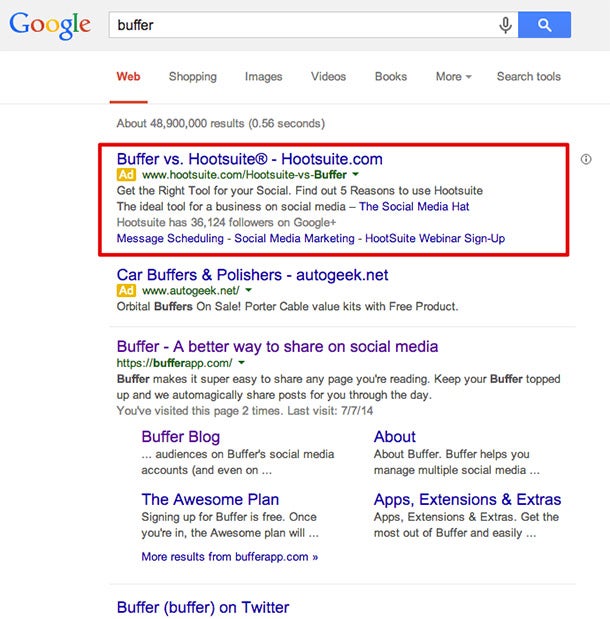
Hootsuite is bidding legally on the term “buffer.” Buffer, the app, controls all the above-the-fold organic listings for their brand name, but they do not have any PPC market share.

Is Paid Search Ineffective for Online Marketing?


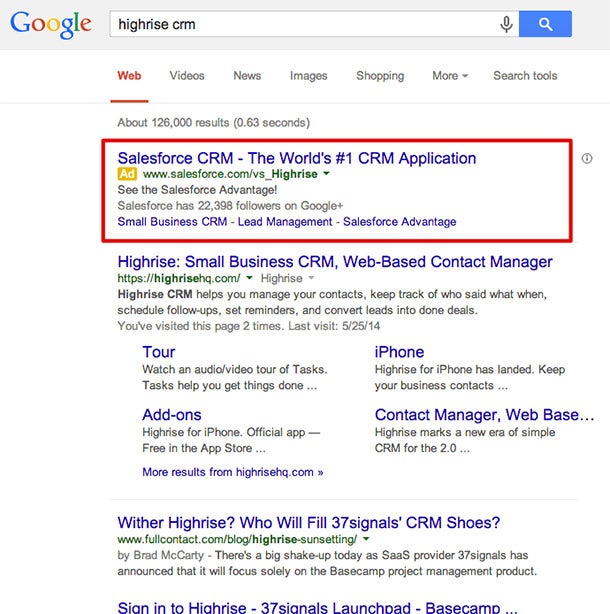
Salesforce bids for the term “highrise CRM.”

Is Paid Search Ineffective for Online Marketing?


If you’re interested in bidding on a branded keyword, you should read the AdWords Trademark Policy, and maybe get some insight from your lawyer. The restrictions are few, but there are some.

The Advertising Blog puts forward these qualifications for bidding on competitor keywords:

  • If it’s not trademarked, you can bid on it

  • If it is trademarked, but the copyright holder hasn’t filed an exception request with Google, you can bid on it AND use it in advertising copy

  • If it’s trademarked and the owner has filed an exception request, you can bid on it, but you can’t use it in your ad copy

  • In the U.S., if you sell a specific product, service it, or provide information about it, you can bid on that keyword and use it in ad copy.

  • Google only monitors certain countries for keyword trademark violations (Australia, Brazil, China. Hong Kong, Macau, New Zealand, North Korea, South Korea. and Taiwan).

3. Emphasize information and content.

I can’t help but end this article with a call to content marketing, with or without the infusion of some extra PPC traffic. Content wins the day. Today’s savvy searchers and shoppers are looking for the best information from the most reliable source. If you provide that great information and reliability, then you’ ll gain the search traffic and conversions that you need.

Do you use paid search? Why or why not? comments below.


Tracking your website analytics isn’t a “set it and forget it” endeavor. As an entrepreneur, it’s important you reevaluate annually what data you’re tracking -- especially important when it comes to SEO. Because Google updates its algorithm so often per year (technically over 500 times, but only three or four of which are usually significant enough to affect your website), the data that truly matters to you can drastically change. In fact, you might even be missing quite a few metrics that should be obvious.

The vast majority of your metrics will come from Google Analytics. This is not to say that Bing reports or any data your social media tools offer isn’t important, but Google has some of the most important metrics to check weekly.

The five reports below are all found on Google Analytics and are listed in order of how they should be checked for the best understanding:


1. Traffic Sources. This will tell you who’s coming to your website and how they found your website. 

This should absolutely be checked once per week. What’s great about this report is it will show you all sorts of data at once so you can take a quicker look (hence why checking it once per week is so possible). For example, you can see which keywords and phrases people are using through search engines as well as links that draw in traffic. By being able to see where all of your traffic is coming from you can better determine where you should put your resources for the most success.

How to improve this report: You will often fine that one aspect of your marketing efforts will drive the most traffic, but another might give you the highest conversion rates. Both are important, so it’s a good idea to know the results each offers so you know where to put your energy. If you check this each week you can start to replicate what you’ve done in past weeks to create the strategy that works best for you. If something changes, you’ll know about it if you’re checking this metric each week and you can alter your efforts accordingly.

I also recommend using Google Analytics Intelligence Events to help you get alerts and better understand your traffic, which you can learn more about here. They’re easy to set up and can make a world of difference.


2. Impressions report. This refers to the number of times any URL from your website appears in organic search results and for what queries.

This hasn’t always been considered an important metric (certainly not top 5) because it doesn’t have to do with people clicking through your website, but now it’s important to know how many people are looking at a particular search term.

How to improve this report: Look at your numbers to help you optimize your website. If a particular search term is ranking well for your site, keep targeted that term in your content and in your paid search efforts. This will change from week to week, so keeping a constant eye on it is key.


3. Conversion Goals report. This is what happens when someone completes a goal that you have created (subscribing to your blog, purchasing something, etc.).

This report is going to let you know how many people are converting and how and why they are converting. In other words, you can see if your efforts—ads, content, landing pages, etc.—are working and where they might be failing. After all, conversions are your ultimate goals and why you work so hard on your website and business in the first place.

How to improve this report: Your conversion rates and how you go about improving these numbers depends on the webpage in question. For example, a call-to-action (CTA) CTR might be different than an email CTR. Nonetheless; there are some tactics that will work across the board. When you group your pages together into similar pages (landing pages vs. blog posts vs. emails, etc.) find the ones with the highest conversion rates. Looking closely at them and find trends that you can then emulate onto your other pages. It seems obvious, but this is something that many companies only do once or twice per year -- not regularly.


4. Blog post views. This is another metric that might not come to mind for many people right off the bat, but it’s still important. Content is everything in today’s SEO world, and for most companies a blog is the biggest way that the company is displaying content. This is the text that ranks and gets people engaged in your website, so shouldn’t it be worth tracking closely each week? Tracking these numbers will help you get feedback on your articles and what your audience likes to read.

How to improve this report: Knowing which blog content performs best will help you determine what to write in the future, but don’t forget to stay creative. You should be publishing content at least three times per week on your blog, so keep trying new things. Your audience also changes as time goes on, so something that might not have been overly successful in the past might perform well just a few months later.


5. Bounce Rate reports. This calculates how long a visitors stays on your page.

This one almost didn’t make the list because bounce rate can is often so high, but that doesn’t mean that the metrics you see are irrelevant. Although your data might be higher than you’d expect, watching this week after week can help you better regulate what is working on your site. The lower the bounce rate the better your site did that week. This often correlates with your blog post metrics.

How to improve this report: Improving your bounce rate numbers is one of the harder things for Webmasters to control. However, the steps you can take to improve your data are the same as many of the others—experiment during the week and see what keeps people on your page. If you do this too infrequently this number might not help you improve, so a weekly basis is a good rule of thumb. Did you use a video last week? Chances are that will improve your bounce rate. Learn more options here or extra tips for creating a sticky website here.

What metrics do you find are important to constantly be watching? Let us know your thoughts and your experiences in the comment section below.


As search engine optimization changes, so do the practitioners of the trade. A few years ago, your average search expert (let’s call them SEOs) could be found creating hundreds of devil-may-care backlinks, stuffing a page with keywords or spinning content for dozens of pages.

SEOs today are more sophisticated. They are curating link profiles, kneading keywords into title tags, and creating a sitemap that is perfect for crawlers.

Meanwhile, there is a breed of SEO that is doing all this and more. These are the SEOs who are pioneering the sites that will dominate the search engine results pages (SERPs) of today and tomorrow.

With one eye on the future, here’s what today’s most innovative SEOs are doing:

1. Implementing ‘schema’ markup everywhere.

Innovative SEOs know that schema markup is the next wave of search innovation -- in which it makes your search listings more visual, so it stands out, which increases your click through rate. Google is constantly trying to refine search results for the good of the end user. Schema, with its powerful Knowledge Graph application, is a sweet spot for SEO application.

It’s no secret that Google favors schema markup. A Searchmetrics study in the spring of 2014 revealed that 0.3 percent of domains use schema markup.

A full 36 percent of Google’s search results include “at least one snippet with information derived from Schema.org.” Even other search engines are wild supporters of schema markup, like Microsoft’s Bing.

There is a shocking disparity between what Google favors and what websites are actually doing. If Google does indeed favor schema markup -- and that 36 percent all but proves it -- then why aren’t more websites implementing schema?

There are several reasons for this:

  • They don’t know what schema elements they should add.
  • They don’t know how to implement schema.
  • They don’t know that it’s a big deal for SEO.

There is a learning curve. The full list of schema is daunting. Where do you even start? Besides, many SEOs don’t have deep training or experience with coding or development.

Thankfully, there are helpful how-to guides and tools that make schema markup less scary.

2. Optimizing for hyperlocal search.

There is evidence from test bucket discoveries that Google is getting smarter about local search results.

Brick-and-mortars that rely on local search optimization have been scratching their heads as to the best way to get on the Google radar. If the algorithm isn’t giving you the search results respect you want, it’s time to ramp up your local game to evolve with Google’s changing local algorithm. The point is this: Innovative SEOs understand that they must optimize a business for local search by emphasizing that business’s neighborhood.


6 Things Innovative Search Engine Marketers are Doing Right Now - google maps


This involves adding descriptors in your business title for Google places, implementing neighborhood name descriptions, optimizing your business website with the neighborhood name, helping Google Maps define your neighborhood, and adding that neighborhood listing to all local citation occurrences.

3. Talking to the company’s content marketers, the developers and the marketers -- basically everybody.

No SEO in a right frame of mind is sitting in his or her cubicle all alone, interfacing with no one. The innovative SEOs have their hand in everything. The digital marketing existence of a business depends on the influence of the SEO.

Here’s where smart SEOs are making their influence felt:

  • Advising the content-marketing team on keyword implementation. Content marketers are usually SEO smart, but they need to be interfacing with the other SEOs on the team in order to amplify their effectiveness.
  • Helping the content-marketing team understand which guest posting opportunities are legitimate. While content marketers survey the blogging landscape for guest posting opportunities, the SEOs should be examining their choices to determine which ones will benefit the link profile.
  • Coaching content writers on SEO best practices such as internal linking, keyword usage, etc. Not everyone understands the value of internal linking, longform copy, no keyword saturation, and other important facts about SEO.
  • Informing the marketing team on organic metrics and ROI. The people who manage pay-per-click (PPC) need to take action based on the information from the SEOs. Why overbid on organic search results that are already highly successful? By dovetailing SEO and PPC, a company can save money and improve paid and organic visibility.
  • Consulting with the developers on SEO best practices for site changes and site redesign. The quickest way for a company to fail is to launch a site redesign without SEO best practices.
  • Sharing critical metrics with executive leadership. Every business leader needs to have “SEO” in the back of their mind as they make important decisions for the company.

SEOs need to have their hands in a lot of pots. They’re not trying to control the company, but their role is more important than ever before.

4. Staying up-to-date on trends and algorithm updates.

Every SEO needs to have an awareness of the big industry and algorithm changes. Duane Forrester of Bing wrote,

Those who seek the trends are better positioned to predict the future. SEOs typically have access to so much data, spotting interesting trends is like a hobby. So a company would do well to exploit that inquisitive nature inherent in SEOs and apply what they can uncover in new directions.

Anybody who knows anything about search will find out about the latest Penguin or Panda rollout. Innovative SEOs are better at predicting these changes, anticipating their effects, and defending against their negative impact.

At the very least, SEOs should keep current with the algorithm change history, such as Moz’s running log.

But algorithm changes are only one part of the vast tectonic shifts that are rumbling in the underground of web marketing. What about web integration into smart cars? How does this impact SEO? Where is wearable technology going, and how might this revolutionize a business’s marketing approach? What impact will cloud payment methods have on the web presence of a brick-and-mortar establishment?

There’s more to search than just search, because search touches on so many other areas. Since SEO is always changing, SEOs need to know what those changes are. More importantly, they need to know how to adapt.

5. Branding emphasis and improvements.

PR and SEO have seen a merger recently. In a slow-but-steady advance of intuitive search, a company’s branded search results have extremely high value. In order for a business to expand its brand footprint, that business must pursue content marketing -- including guest posting -- with abandon.

This is apparent on a personal level. For example, I’ve invested a lot of time and effort into personal branding and web presence, because I see the huge impact this has upon my business. As one Search Engine Journal article reported,

You can’t expect to “do SEO” without thinking of PR. This is especially true for individuals — thought leaders, entrepreneurs, and niche experts. Their public stature has everything to do with the optimization of their web presence.

Exhibit A of this shift is the progress and impact of Google Authorship. But the less-talked about impact is how this affects company branding and public relations. A company’s branding and PR reside heavily in the online space. It’s called SEO.

As the SEJ article went on to explain, SEO and PR need to be thought of, not as two separate disciplines, but as two sides of the complex polygon known as “digital marketing.”

Smart SEOs dare to go where no SEOs have gone before — to sally forth in the complexities of PR, and discover the value.

6. Thinking high-level strategy and tech-level implementation.

Smart SEOs are able to lift their heads from a morass of links, data, and ranking and think “what impact does this have on the business as a whole?”

I envision an era where SEOs sit across the table from CEOs to explain what’s happening and how to fix it. SEOs are awash in a sea of metrics, data, information, and market intelligence. They possess the skill to distill this data into action points and forward progress.

SEOs, of all people, should have the skills and knowledge to point to a company’s future and instruct its decision making. I’ve seen smart consultative SEOs sketch out massive changes that prompt incredible change in an organization. This is as it should be.

SEO has risen from its spam-ridden, scam-threatened origins to become one of the most highly-valued skillsets in web marketing. SEOs shouldn’t be afraid to assert their knowledge and expertise to make high-level strategic suggestions.

Conclusion

We’re cruising into an age where SEOs are taking the lead as innovators and strategists. Are we going to let the change revamp the marketplace around us, or are we going to direct the change ourselves? I think we can do the latter.

That’s what I’m trying to do at least.

What skills and activities should SEOs cultivate?


Just a few years ago, search-engine optimization  was widely considered a specialized knowledge of how to manipulate Google’s search rankings with clever, secret tactics. While that was an accurate assessment then, the SEO industry has matured. It is now a dynamic, multifaceted online marketing discipline that transcends clever trickery, and has become an essential requirement of expertise for every online marketer.

Google has facilitated and accelerated this shift  by changing the game in ways that help users find information faster and in a manner that emphasizes the giant's own products. So  how is SEO evolving, and what is Google’s goal? What can online marketing professionals learn about the future best practices of the SEO industry by studying Google’s present pattern of changes? Read on.

1. SEO is now more about building a brand than manipulation or trickery.

Changes over the past two years already have shifted our perception of search-engine optimization. We' re no longer talking about just links, keywords and PageRank.  Instead, we' re discussing branding and content strategy. But building a brand and publishing high-quality content are not new concepts, they’ ve always been key parts of inbound marketing. So  why the sudden shift in buzz within the SEO industry?

Google’s launch of its Penguin and Panda algorithm updates sent a clear message to webmasters and marketing professionals: Google will not tolerate manipulative tactics  or low-quality content in its search results. The result? A strategic, quality content strategy became the only option to achieve visibility in search results.

A content strategy is only effective, however, when executed by a strong brand, otherwise, that content achieves little reach, viewership  or audience. Simultaneously, an effective content strategy is the road to building a brand. As a result, the focus is now on content and branding rather than manipulation and trickery.

2. Google is no longer just a search engine.

Yes, Google started as a search engine and it continues to serve that function. But Google has also become the leader in consumer-facing, data-oriented projects. Knowledge Graph, which attempts to figure out what searchers want, quickly supply the information and anticipate the next questions, is one example.

Many searches are location-based. “ Vegan restaurants in Brooklyn”, “ Spas in Brisbane”, “ Where do I get designer shoes in Milan?” All these queries return search results that are peppered with extra information, from reviews to price ranges to maps. Throw in paid ads, which dominate the top spots in the rankings, and the top-ranking organic search result now appears a few hundred pixels down the page. That number-one ranking has lost a significant amount of value and visibility.

3. Links are key, but for a different reason.

Currently, it’s widely thought that the quantity and quality of inbound links to your domain and individual pages on your site are the primary factors in the ranking algorithm. Because of the resulting market for link buying and selling (which Google hates), Google might be tweaking its algorithms to give lower algorithmic weight to inbound links. However, even if links become irrelevant for SEO purposes, that doesn’t mean they won’t still be vital for your online marketing campaign.

Before anyone knew what SEO was, they tried to get other websites to link to theirs for a different reason: referral traffic. How does John Doe discover your website if not via Google? Maybe he sees it mentioned on a blog. Maybe he found you on Twitter  or Facebook. Or maybe he saw a sign you put up in the offline world. In every case, he arrived at your website through a “ link.”

Ask yourself: If Google were not in the picture, would marketers still need to build links? If you’ re in it for the long term, the answer is yes.

4. The future is “Now.”

Google Now is more than a mobile voice search challenging Apple’s Siri. It’s an entirely different mindset that pulls answers from geolocation, search history, and preferences, as well as recent activity on Google products and other places.

It can search your calendar for birthday reminders. It can find your travel itinerary in your Gmail and spit out a weather report for where you’ re headed. The emphasis is on serving answers, not web page results. The challenge is making yourself relevant enough in people’s lives so that you show up in search results.

Because most of this takes place on mobile devices, SEO also means optimizing websites to be mobile-friendly.

5. Approach online marketing with a “product” perspective.

If you have a bad product, you can sell a few units through excellent marketing.  But this strategy not only won’t last long -- it’ ll kill your brand as the word spreads. This is why you should treat every aspect of your inbound marketing campaign as a product.

Consider content as your chief product. Content can be a blog post, an ebook, a video, an email newsletter, an infographic  or just about anything that's going to be consumed by an audience.

As marketers and advertisers, we tend to value campaigns (the process) over the product. But the opposite philosophy is your ticket to long-lasting success. Apple has created great marketing campaigns, but their focus is always on creating the best products.

Conclusion.

The irony is that many folks who try hard to get that number-one ranking in the search results often fail while brands and marketers who patiently and systematically follow these steps not only reach their goals but stay there over the long haul.

Google has carefully crafted its strategy to encourage strong, a quality content publication so its users don’t have to see the spammy content that used to litter its search results. Google’s future moves will be to further encourage this trend of quality and branding instead of manipulation and trickery.


Although online directories are still a part of every complete strategy for search engine marketing and optimization, they don’t hold the power they once did. We spoke with marketing experts on the role online directories should play now and how they fit into your digital strategy. Here’s what they said:


Understand lists’ new role

Getting a website listed on a directory used to be to be an easy path to traffic and success. In those days, getting linked on a site with a high page rank would increase your score with search engines. These days, however, Google and other search engine companies have grown wise to how websites and their owners have exploited the previous system. " These links worked extremely effectively for boosting rankings, but they violated Google's Webmaster guidelines, as the only purpose they served was to boost rankings unnaturally for the linked websites," says Jayson DeMers, founder and CEO of AudienceBloom.

Eric Siu of Single Grain says that directories should be seen as just one more tool in your toolbox, and not your first and only option. " Directories still hold a little bit of value, but.. you' re better off creating exceptional content that stands out and promoting it through social media." He says you should focus more on original content that’s compelling and share-worthy and building real relationships with real authorities in your space. Think about what users will be searching for and what they want. Content that answers the queries your customers are typing into search engines will be more valuable than mere directory listings.


Quality over quantity?

When considering directories, look for ones that use editors and require fees. Each of our experts recommends Dmoz.org, an open-content directory that’s maintained by a community of volunteers called the Open Directory Project. " That's one of the largest directories on the web," marketing consultant Brian Honigman says. " Google and all of the search engines take it into consideration when they decide how to best categorize your website." Dmoz has human editors who oversee every application to ensure accuracy, a sharp contrast to the vast majority of online directories, that are automated, easy to manipulate, and more likely to be due punishment by Google.

DeMers also recommends getting your site listed on botw.org and Yahoo's business directory. "[These] can help with SEO because they are typically considered strong links from respected, editorially-selective publishers," he says.

Beyond that, be diverse but picky. The money spent on getting listed in online directories could be spent elsewhere, especially if you’ re a young, cash-strapped business. " The most common way to mess up is to get listed in too many low qualities [directories] that Google would consider spammy," DeMers says.

Adds Siu, "You're probably better off spending that $200 somewhere else."


Be professional

Since the modern directories that actually improve your SEO are all carefully moderated by human editors, ensure that your site is fully optimized and professional before submitting. For instance, your pages should be easy to read, with type that’s clear and legible. " The only reason you wouldn't be accepted is if your website was a mess and didn't look credible," Honigman says.


Don’t be clever

You should abandon all of the old, spam-driven tactics when you submit your site. " Another way to mess up is to use exact-match keyword-rich anchor text when linking to your website," he says. Any attempt to exploit the system will only get your site flagged by Google.


Work your niche

Find smaller directories that cater to your niche. " If you have an interior design site and get listed on an interior design directory you could hold more value," Siu says. SEO can be fickle when it comes to directories, but this tactic could help a more eclectic business get noticed.

This can be especially helpful for new companies who do exclusively local business. DeMers suggests looking into local online directories like MerchantCircle and SuperPages but adds that these won't make sweeping changes to your search engine results. " Getting published in each local directory is beneficial mostly for local SEO and marginal for national SEO," he says.


Search marketing has grown in popularity as an online search continues to evolve from a novelty to a standard feature in our everyday lives. Almost every business in the country, big or small and regardless of industry, has some kind of web presence, and everybody is competing for only a handful of positions at the top of search-engine results pages (SERPs).

Since larger companies -- mega-corporations such as Walmart or Home Depot --  already have millions of inbound links, decades of content, and a recurring base of online visitors, it’s no wonder why they generally appear in the top ranking positions when people search for commercial products. Regardless of what industry you’ re in, you’ ll always have at least one competitor who has been around longer and has tried harder than you have (allocated more budget and resources) to building their visibility on the web and in search engines.

So how can you, a small business with limited experience and resources, compete with that level of online domination?

Thankfully, search-engine optimization (SEO) is no longer about sheer volume. It’s not about who’s been on the web the longest, who has the most inbound links, or even who has the biggest library of great content. It’rsquo;s about which page or website is the most relevant for the searcher. Knowing that, there are several strategies you can implement that can give you the edge over the bigger, worse competition.

1. Specialize in a niche.

One of the best things you can do as a small business is give yourself a niche focus. Instinctively, you might think that the better option for search visibility is to cover as many areas of expertise as possible. For example, if you work in heating, cooling, plumbing, roofing, construction  and a dozen other home improvement topics, you’ ll be able to appear in search engines for queries related to any of those keywords.

However, if you’ re trying to take down your biggest competitors, it’s better to take more of a niche focus. Having several areas of specialization gives you relevance for a wide range of keywords, but your relevance for each of them is somewhat low. If you pour all your effort into one or a small handful of keywords, you’ ll be able to achieve a much higher visibility.

For example, if you specialize in indoor plumbing, you might miss out on limited visibility for all those other home improvement keywords, but you’ ll be the best in indoor plumbing.

2. Engage in a long-tail keyword strategy.

Long-tail keyword strategies try to accomplish a similar goal. In niche specialization, you sacrifice minimal relevance in a large volume of topics for maximum relevance in a much smaller volume of topics. With long-tail keywords, you’ ll be sacrificing minimal ranking potential with highly popular keywords for maximum ranking potential with less popular keywords.

Long-tail keywords are extended phrases Google looks for, such as “ tips for installing a toilet in an upstairs bathroom” instead of the much shorter, more popular “ toilet installation.” Ranking highly for long-tail keywords is much easier than ranking high for shorter keywords, so even though they bring in less traffic, they’ re still more valuable for small businesses to go after.

Fortunately, optimizing for long-tail keywords is easy. You can research ideal long-tail keywords to go after using Webmaster Tools, or you can just publish lots of great content -- long-tail keyword phrases tend to appear naturally in the course of your writing. For further information on identifying and using long-tail keywords, see “The Rise of the Long-Tail Keyword for SEO” and “How to Find Long-Tail Keywords Once You’ve Identified Your Primary Keywords.”

3. Leverage locality for optimization.

Another way to beat the competition is by targeting a much more local audience. Local search is becoming more relevant and more important, so in today’s context, being the best barber shop in Houston is far better than being an OK barber shop on a national scale.

Even if your business does operate on a national (or international) level, you can still capture a niche market share and edge out your competition in at least one key area by optimizing for a specific local area. In this section, I’ ll introduce a handful of specific strategies you can use to build your reputation and relevance in your given city.

Event attendance and community building. Get your name out there by getting involved in the community. Attend major events whenever you can, such as fairs, festivals  or community gatherings. This will give you two opportunities: First, you’ ll immediately  generate more business simply by being at the event and offering discounts or promotions to event attendees. Second, and more importantly for SEO, you’ ll have the opportunity to brag about your attendance online.

Post excellent content on your website, using local-specific keywords, about your company’s attendance, and syndicate a press release about the opportunity for some high-authority and local-specific inbound links. This is one of the easiest ways to generate publicity and build some local-optimized content simultaneously.

Local reviews, on directory and aggregation sites such as  Yelp or TripAdvisor, have become essential for local SEO. With Google’s Pigeon algorithm update earlier this year, Yelp and similar sites received a huge boost in priority. Now, sites with large volumes of positive reviews rank higher than similar sites with few or negative reviews. In fact, Yelp’s importance has increased so much that, in some cases, Yelp profiles are actually ranking higher than the official pages of the companies they represent.

What this means for small businesses is a new, key opportunity to jump in the rankings without worrying about producing content or building links. Instead, you can focus on cultivating strong, positive reviews from your customers. While Yelp explicitly forbids compensating your reviewers or asking customers directly for reviews in any way, you can still encourage more reviews with Yelp stickers and occasional call-outs with a link on your social media profiles.

Hyper-local content. Local search is getting more local, and taking advantage of that incoming trend could be the opportunity you need to crush a larger competitor -- especially if that competitor operates in the same city as you.

Google is getting better at identifying and categorizing neighborhoods within a broader city, so you can take local search a step further by using neighborhood-specific keywords instead of just city and state names. Your potential success is determined by how Google views your neighborhood boundaries, so do some research before you begin.

4. Personalize your social engagement.

Aside from local search optimization, you can also increase your chances of overcoming steep competition by stepping up the “personal” factor in your brand strategy. Large businesses tend to lose a portion of their personalities once they hit a certain point in their growth, but being small and nimble gives you the advantage of giving each follower a more personal, humanized experience.

Nurture your following on social media, and you’ ll attract more posts and followers, and the bigger and more active your social-media presence is, the higher you’ ll rank in Google.

5. Become a recognized, authoritative content publisher.

Building brand awareness, loyalty, trust  and credibility requires frequent and quality content publication. Most companies utilize an on-site blog to publish content, while others produce and distribute ebooks, webinars, podcasts, videos and other forms of content through various other channels.

The keys to building your brand through a content strategy are quality and consistency. Maximize the reach of each piece of content you publish to maximize your return on investment, and be consistent with your publication schedule so you start to become recognized as a dependable authority.

Conclusion

There’s no shortcut to rise to the top of the search engine rankings, especially when there’s a massive competitor lingering on the scene. But with a strategy that leverages your geographic location and your ability, you can selectively overcome your competitors in specific key areas.

Give yourself the best odds by narrowing your topic and keyword focus  and increasing your location-specific relevance. You might not rank for as many keywords as the bigger players, but you will be able to surpass them in relevance for your chosen focal points.


Most websites are only optimized for the country that the business lives in, but for companies to expand, they should also optimize for international search. Search engine optimization continues to be the most effective way to drive traffic to a website. Focusing on one market may limit traffic and revenue if you aren’t thinking about international customers.

To expand to an international focus, keep these guidelines in mind:

Consider keywords in other languages

Make sure that you have considered keywords in other languages. Even if your site is English only, people will often search in their native language. If your site is optimized for keywords in other languages, you will show up in a search. From there, chances are that the person looking will still be able to use your site. If the person does not speak English, he or she will be able to use tools like Google to translate the page and get an understanding of the products and services you sell.

Provide domains that are country-specific

Most countries have their own domain extension. German websites, for example, most commonly end in “.de” rather than “.com”. In order to make your website friendly for international search, it is beneficial to create landing pages with different domains for different countries. Search engines in-country will pick up the site that is most relevant for their market. For example, www.website.de would rank higher in Germany than www.website.com. 

Translate content when possible

It is not essential to translate entire websites for international search since English is so commonly read and spoken. However, it is important to have at least some content translated and localized for international markets so that the site is relevant for search engines. Some websites have sections of the website that are translated with a disclaimer that only some of the content could be translated for local languages.

Focus on on-page SEO

Make sure to consider the following on-page SEO guidelines for international search engines:

  • Alt Attributes and Imagery – Alt attributes and images need to have keywords and those keywords should be in all relevant languages.
  • Consistent Mapping – If you do use the local domain, e.g. “.de”, make sure that that all navigation links on that domain also lead to a “.de” page. This tells Google that this page is in German and that the site is relevant for the German market. Also, make it easy for the user to be able to switch languages if you are not able to translate the entire website. Then he or she can get full content on the main site.
  • Keywords – It is important to do keyword research for each region that you are selling to. Doing translation of your English keywords alone is not the most effective way to find the appropriate keywords for your target country. Think of how many ways we say different words in English. If there was just one translation, you might miss the most commonly searched terms.
International Social Media

Social media sites are not the same for all countries. For example, while professionals in the US use LinkedIn as their professional networking site, people in Germany use Xing. To further optimize for international search, set up social media pages for each market and populate them with rich content that contains keywords.

By considering the above, your international SEO strategy can be as smooth and effective as your domestic one.